
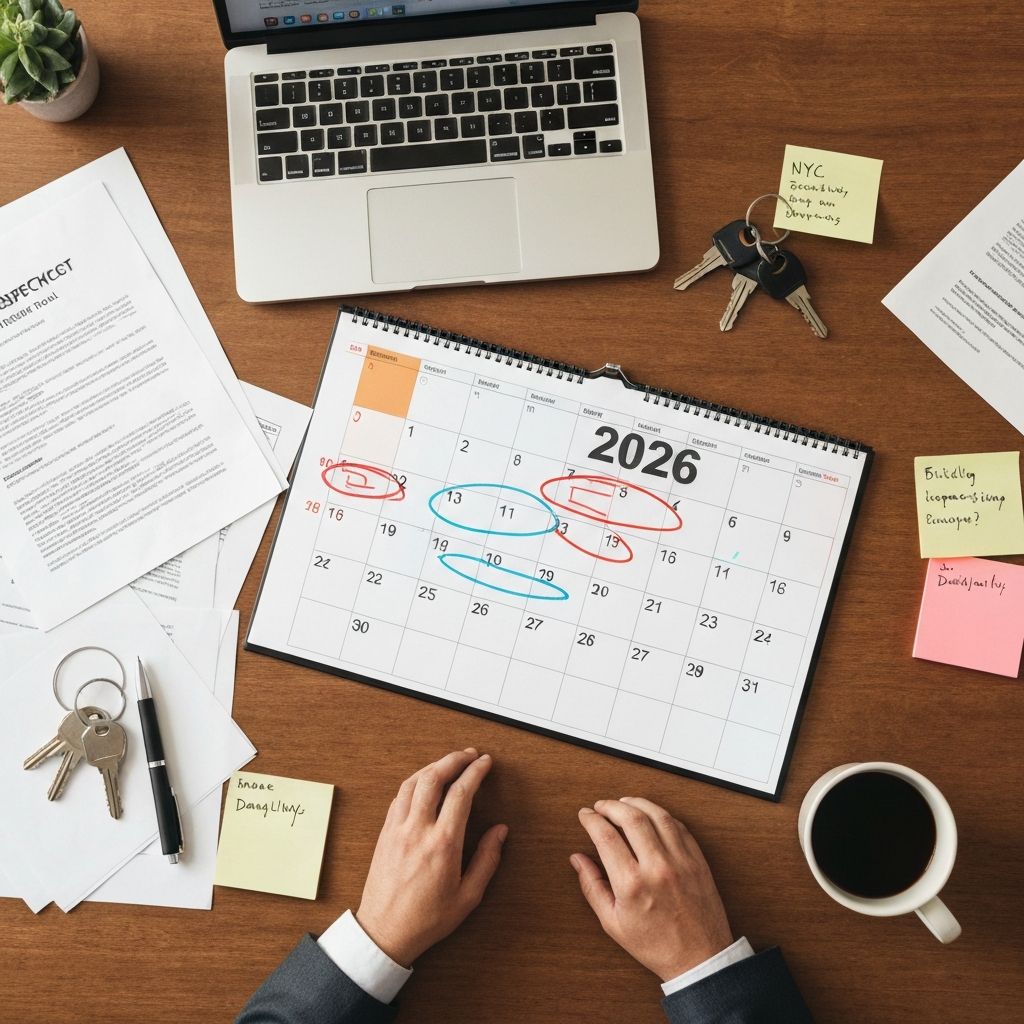
If you own or manage a building in New York City, you are dealing with one of the most complex regulatory environments for real estate anywhere in the country. Between the Department of Buildings (DOB), the Fire Department (FDNY), the Department of Environmental Protection (DEP), and the Mayor's Office of Sustainability, the number of inspections, filings, certifications, and reports you need to keep track of each year is staggering.
Miss a deadline, and the consequences range from fines in the hundreds of dollars to penalties in the millions. Some violations can even trigger building vacate orders.
This calendar consolidates every major NYC building compliance deadline for 2026 into one resource. It is organized by quarter, with the specific requirements, who they apply to, and what you need to do for each one.
Bookmark this page. Share it with your property manager. Print it and tape it to the wall in your office. This is the reference you will come back to all year.
How This Calendar Is Organized
Each deadline is listed under the quarter in which the filing or inspection must be completed (or initiated). Some requirements have fixed calendar dates. Others are rolling deadlines based on your building's specific cycle or last filing date.
For each requirement, we include:
- What it is: the law or regulation
- Who it applies to: building types and sizes
- What you need to do: the specific action required
- The deadline: when it must be completed
- Penalties for non-compliance: what happens if you miss it
Note: Some deadlines are based on your building's assigned filing cycle (FISP sub-cycles, for example, are determined by block number). Check your specific cycle assignment on DOB NOW or DOB BIS if you are unsure.
January Through March 2026
Local Law 126: Annual Parapet Inspection
Ongoing, Due December 31What it is:
Local Law 126 of 2021 requires annual inspections of parapets and parapet-related appurtenances on buildings where these elements are adjacent to public right-of-way (streets, sidewalks, plazas).
Who it applies to:
Virtually all NYC buildings with parapets along a public street or sidewalk, with limited exemptions for certain 1 to 3 family residential buildings.
What to do in Q1:
Schedule your 2026 inspection. Q1 is the ideal time to book, giving you a full year to complete the inspection and address any findings before the December 31 annual deadline.
Full requirements: Complete Guide to Local Law 126 Parapet Inspections.
Penalties:
$1,250 per month for failure to file, up to $10,000 per year. Buildings with unaddressed Unsafe conditions face additional enforcement actions.
Local Law 97: Annual Emissions Reporting
What it is:
Local Law 97 of 2019 (the Climate Mobilization Act) sets carbon emissions limits for large buildings. Building owners must report annual emissions, and buildings exceeding their limits face financial penalties.
Who it applies to:
Buildings over 25,000 gross square feet (or two or more buildings on the same lot exceeding 50,000 gross square feet combined). This covers approximately 50,000 buildings citywide.
What to do in Q1:
Gather your 2025 utility data (electricity, natural gas, fuel oil, steam) to prepare your annual emissions report. The reporting period covers the previous calendar year's emissions. Verify your building's emissions limit for the 2024-2029 compliance period.
Deadline:
May 1, 2026 for 2025 calendar year emissions data. The reporting is done through the DOB's benchmarking portal.
Penalties:
$268 per metric ton of CO2 equivalent exceeding the building's annual limit. For a large office building, this can exceed $1 million per year. There is no cap.
Local Law 33 / Local Law 95: Benchmarking and Energy Efficiency Grades
What it is:
Local Law 33 of 2018 requires covered buildings to post an energy efficiency grade (A, B, C, D, F, or N) near a public entrance. The grade is based on the building's ENERGY STAR score as reported through benchmarking under Local Law 84/133. See the full breakdown in Local Law 33 and energy grades explained.
Who it applies to:
Buildings over 25,000 gross square feet (same population as LL97). The grade is based on the prior year's benchmarking data.
Deadline:
May 1, 2026 for 2025 benchmarking data. The letter grade must be posted at the building within 30 days of receiving it from the city.
Penalties:
$1,250 per quarter for failure to benchmark. Separate $1,250 penalty for failure to post the energy grade.
Elevator and Escalator Inspections (Category 1 Annual Test)
What it is:
All elevators, escalators, and other conveyance devices in NYC must undergo annual Category 1 safety testing and a periodic (every 5 years) Category 5 full-load test.
Who it applies to:
All buildings with elevators, escalators, dumbwaiters, or other DOB-regulated conveyance devices.
Deadline:
Annual, based on your building's assigned testing cycle.
Penalties:
$1,000 to $5,000 per device for overdue inspections. Devices that fail inspection may be ordered out of service until repairs are completed.
FDNY Annual Fire Safety Inspections and Certifications
What it is:
The FDNY requires annual inspections and certifications for fire alarm systems, sprinkler systems, standpipe systems, and fire suppression systems. Building owners must also maintain a Fire Safety and Evacuation Plan (FSEP) that is updated annually.
Who it applies to:
All commercial buildings, residential buildings over 6 stories or with more than 2 dwelling units and a shared fire alarm system, and any building with sprinkler or standpipe systems.
Deadline:
Various. Most certifications are due annually from the last filing date. Check your specific system's last filing date on FDNY's certificate tracking portal.
Penalties:
$2,500 to $10,000 per violation. Non-functional fire suppression systems can result in immediate vacate orders.
April Through June 2026
FISP / Local Law 11: Facade Inspection Filing
What it is:
The Facade Inspection and Safety Program (FISP), originally enacted as Local Law 11, requires periodic inspection of exterior walls and appurtenances for buildings taller than 6 stories. Inspections must be performed by a Qualified Exterior Wall Inspector (QEWI).
Who it applies to:
All buildings greater than 6 stories in height. NYC is currently in FISP Cycle 9 (2020 to 2027). Your building's specific filing deadline depends on your assigned sub-cycle.
If you are subject to both FISP and Local Law 126, understand how the two interact. See the comparison of parapet inspections and FISP.
Penalties:
$1,000 per month for late filing. If an Unsafe condition is found, immediate notification within 24 hours and public protection (sidewalk shed) is required. Total penalties for non-compliance can reach $10,000+ annually.
Local Law 97: Emissions Report Filing Deadline
FIXED DEADLINE: May 1, 2026If you prepared your 2025 emissions data in Q1, this is the filing deadline. Submit through the DOB's benchmarking and LL97 reporting portal. Buildings in compliance with their emissions limits will receive confirmation. Buildings exceeding limits will receive penalty assessments.
Benchmarking (Local Law 84/133): Filing Deadline
FIXED DEADLINE: May 1, 2026Local Law 84 (as amended by Local Law 133) requires covered buildings to annually benchmark their energy and water consumption using EPA's ENERGY STAR Portfolio Manager. This data feeds into the LL33 energy grades and LL97 emissions tracking.
Who it applies to: Buildings over 25,000 gross square feet.
Penalties:
$500 per month beyond the deadline, up to a maximum annual penalty.
Boiler Inspections (Annual)
All boilers operating under DOB permits must have an annual inspection performed by a DOB-licensed boiler inspector. Reports must be filed with the DOB.
Who it applies to: All buildings with boilers operating under DOB permits. This includes virtually every building with central heating in NYC.
Recommended timing: Most building owners align inspections with the end of heating season (April or May) for practical reasons.
Penalties:
$500 to $2,500 per violation for operating a boiler without a current inspection certificate. Severe deficiencies can result in an order to shut down the boiler.
Cooling Tower Registration and Testing
Before Seasonal OperationLocal Law 77 of 2015 requires all cooling towers in NYC to be registered with the DOB and tested regularly for Legionella bacteria. Towers must be tested within 15 days of seasonal startup and at least quarterly during operation.
Who it applies to: All buildings with cooling towers, evaporative condensers, or fluid coolers.
Penalties:
$500 to $2,000 per day for operating an unregistered tower. Positive Legionella results require immediate remediation and retesting.
July Through September 2026
Sprinkler System 5-Year Tests (If Due in 2026)
In addition to annual inspections, building sprinkler systems must undergo a comprehensive 5-year internal inspection and testing. This includes hydrostatic testing of piping, internal inspection of sprinkler heads, and obstruction investigation.
Who it applies to: All buildings with sprinkler systems where the 5-year test cycle falls in 2026.
What to do: Check when your last 5-year test was performed. If it was 2021 or earlier, schedule the test with an FDNY-licensed fire suppression contractor.
Penalties:
$2,500 to $10,000 for non-compliance. Expired certifications can trigger FDNY enforcement inspections.
Backflow Prevention Device Testing (Annual)
NYC DEP requires annual testing of all backflow prevention devices to prevent contamination of the public water supply.
Who it applies to: All buildings with installed backflow prevention devices.
What to do: Schedule annual testing with a DEP-certified backflow tester. If a device fails testing, it must be repaired or replaced and retested within 30 days.
Penalties:
$1,000 for the first offense, up to $10,000 for repeat offenses. DEP can also order water service disconnection.
Local Law 152: Gas Piping Periodic Inspection
Rolling DeadlineLocal Law 152 of 2016 requires periodic inspection of gas piping systems in buildings. Inspections must be performed by a licensed master plumber.
Who it applies to: All buildings in NYC with gas piping. Community District-based inspection cycles determine your deadline.
What to do: Check which Community District your building is in and determine if 2026 is your filing year. The plumber must access all gas piping and appliances, which requires coordination with individual tenants for apartment access.
Penalties:
$10,000 for failure to have the inspection performed. $5,000 for failure to correct conditions found during the inspection.
Scaffolding and Sidewalk Shed Permits (Renewal if Active)
All scaffolding and sidewalk sheds in NYC require active DOB permits. Permits must be renewed before they expire. If your building currently has a sidewalk shed (from a previous Unsafe parapet or facade finding, for example), its permit needs to be current. See our overview of scaffold inspection requirements.
Penalties:
$2,500 to $25,000 per violation for expired scaffold or shed permits. DOB can order immediate removal of non-permitted structures.
October Through December 2026
Local Law 126: Annual Inspection Completion
HARD DEADLINE: December 31, 2026Your annual parapet inspection must be completed and documented by this date. If you scheduled in Q1 or Q2 (as recommended), you should already have your report.
If you have not yet completed your inspection, schedule it immediately. Use the parapet inspection checklist to prepare, and contact an inspection company now to secure availability before year-end demand spikes.
Common Q4 mistake:
Waiting until December to book an inspection. By then, qualified inspection companies are overbooked and may charge rush fees. Some may not have availability at all. If you get an Unsafe finding in December, you have almost no time to arrange public protection and begin repairs before additional violations accrue.
Heating Season: Boiler Startup and Compliance
October 1NYC Housing Maintenance Code requires building owners to provide heat to residential tenants from October 1 through May 31 (heat season). Between 6 AM and 10 PM, if the outside temperature falls below 55 degrees Fahrenheit, indoor temperature must be at least 68 degrees. Between 10 PM and 6 AM, indoor temperature must be at least 62 degrees regardless of outside temperature.
What to do: Complete any boiler maintenance or repairs before October 1. Test-fire the boiler system in September to identify and fix issues before heat season begins.
Penalties:
HPD heat complaints can trigger immediate inspections and violations. Penalties range from $250 to $1,000 per day. Repeat offenders can be placed on the city's Worst Landlords Watchlist.
FDNY Annual Statement of Compliance
Due by Anniversary DateBuilding owners must file annual compliance statements with FDNY for fire alarm systems, sprinkler and standpipe systems, smoke detection, and carbon monoxide detection. Certificates of Fitness must also be renewed on schedule.
Penalties:
$500 to $5,000 per expired certificate. Non-functional or unmonitored fire alarm systems can result in immediate vacate orders for commercial occupancies.
Year-End Records Review
Q4 is the time to audit your complete compliance file for the year. Confirm that every required inspection, test, and filing has been completed:
- Local Law 126 parapet inspection report: on file
- FISP report (if due in 2026): filed with DOB
- LL97 emissions report: filed by May 1
- LL84/133 benchmarking: completed by May 1
- LL33 energy grade: posted at building entrance
- Elevator Category 1 tests: completed and filed
- Boiler inspection: completed and certificate current
- Fire alarm and sprinkler certifications: current with FDNY
- Backflow preventer testing: completed and filed with DEP
- Gas piping inspection (LL152, if due in 2026): filed with DOB
- Cooling tower registration and testing: current with DOB
- Scaffold/shed permits (if applicable): current
Rolling and Ongoing Compliance Requirements
Some compliance requirements do not have a specific calendar deadline. They are rolling, ongoing, or triggered by specific events.
DOB Violation Resolution
Any open DOB violations should be resolved as quickly as possible. Violations carry daily or monthly penalties that accrue until resolved.
- Class 1 (Immediately Hazardous): Corrected immediately. $2,500 to $25,000.
- Class 2 (Major): Corrected within 40 days. $500 to $10,000.
- Class 3 (Lesser): Corrected within 40 days. Up to $500.
Construction and Alteration Permits
All construction, alteration, and renovation work requires DOB permits (unless specifically exempt for minor work). After-hours and weekend work requires separate permits and DOB approval. Active permits must be renewed before expiration.
Lead Paint (Local Law 1 / EPA RRP Rule)
Applies to: Residential buildings built before 1978 with children under 6 in occupancy.
Conduct annual visual inspections of painted surfaces. Remediate any deteriorated lead paint using EPA-certified contractors. File annual lead paint survey results with HPD if required.
Asbestos (ACP-5 / ACP-7 Filings)
Applies to: Any building undergoing renovation, demolition, or construction that may disturb asbestos-containing materials.
Have an asbestos survey performed before any work. If asbestos is found, file an ACP-5 with DOB at least 10 days before work begins.
HPD Registration (Annual)
Applies to: All residential buildings with 3 or more dwelling units, and all condominiums.
Registration must be current at all times. Failure to register can prevent a building owner from collecting rent increases or commencing certain legal proceedings.
Stormwater Management (DEP Compliance)
Applies to: Buildings with CSO areas, green infrastructure under DEP agreements, and major construction triggering stormwater requirements.
Maintain green infrastructure per DEP agreements. Document maintenance activities for potential DEP audits.
Penalties Quick Reference
Here are the penalty ranges for the most common compliance failures, in one place for reference:
| Requirement | Penalty Range |
|---|---|
| Local Law 126 (parapet inspection) | $1,250 to $10,000 per year |
| FISP (facade inspection) | $1,000 per month for late filing |
| Local Law 97 (emissions) | $268 per metric ton over limit (no cap) |
| LL84/133 (benchmarking) | $500 per month |
| LL33 (energy grade) | $1,250 per quarter |
| Elevator inspections | $1,000 to $5,000 per device |
| Boiler inspections | $500 to $2,500 per violation |
| FDNY fire safety | $500 to $10,000 per violation |
| Local Law 152 (gas piping) | $10,000 for non-compliance |
| Cooling towers | $500 to $2,000 per day |
| DOB Class 1 violations | $2,500 to $25,000 |
| Backflow devices | $1,000 to $10,000 |
These penalties are per occurrence or per period, and they compound. A building that falls behind on multiple requirements can accumulate tens of thousands of dollars in fines within a single year.
How to Stay on Top of All of This
The sheer number of compliance requirements can be overwhelming, especially for owners or managers of multiple buildings. Here is a practical approach:
Build a Compliance Tracking System
Whether you use a spreadsheet, a property management platform, or a dedicated compliance tracking tool, create a master list of every requirement that applies to each building you manage. For each one, track:
- The requirement (law/regulation)
- Your building's specific deadline or cycle
- Last completion date
- Next due date
- Responsible person (who owns this task)
- Status (scheduled, completed, overdue)
- Filing confirmation or certificate number
Set Calendar Alerts 90 Days in Advance
For every deadline, set a reminder 90 days before the due date. This gives you enough lead time to schedule inspections, gather documentation, and coordinate with contractors. For requirements with longer lead times (FISP, LL97 reporting), set an additional alert 6 months out.
Designate a Compliance Coordinator
For larger buildings or portfolios, assign one person the explicit role of tracking and managing compliance deadlines. This person does not need to perform every inspection, but they need to own the calendar and ensure nothing slips through the cracks.
Use DOB NOW and BIS Proactively
The DOB NOW portal and BIS (Building Information System) contain your building's compliance history, open violations, permit status, and filing records. Check these at least quarterly to confirm your records match what the city has on file. Discrepancies caught early are much easier to resolve than surprises during an audit.
Build Relationships with Reliable Service Providers
Having trusted, responsive inspection and maintenance companies for each compliance area (parapet/facade, elevators, boilers, fire protection, plumbing) is the biggest practical advantage you can have. They understand the requirements, they file on time, and they let you know when something needs attention before it becomes a violation.
Frequently Asked Questions
Does this calendar cover every possible building compliance requirement in NYC?
It covers the major requirements that apply to most buildings. Some specialized occupancies (hospitals, schools, places of assembly, industrial facilities) have additional requirements specific to their use. If you operate a specialized facility, consult with a code compliance professional for a complete list.
My building is a small residential property (1 to 3 units). Do all of these apply to me?
Smaller residential properties are exempt from many of these requirements. LL97, benchmarking (LL84/133), and LL33 only apply to buildings over 25,000 square feet. FISP only applies to buildings over 6 stories. However, Local Law 126 (parapet inspections), boiler inspections, and fire safety requirements generally apply to all building types.
Where do I check my building's specific FISP sub-cycle deadline?
You can look up your building on DOB BIS (the Building Information System) at the DOB website. Enter your address, go to the FISP section, and you will see your assigned sub-cycle and deadline.
What happens if I discover that a previous owner missed filings before I bought the building?
Compliance obligations run with the building, not the owner. If the previous owner missed filings or inspections, you are responsible for bringing the building into compliance. Start by running a full compliance check on DOB NOW and BIS to identify any gaps or open violations, and address them in priority order.
Can one inspection company handle both my Local Law 126 and FISP inspections?
Yes, as long as the company employs QEWIs (Qualified Exterior Wall Inspectors) for FISP and qualified inspectors for LL126. Using the same company for both can improve coordination and reduce costs, especially in years when your FISP cycle and LL126 inspection overlap.
Is there a city tool or portal that tracks all of my compliance deadlines in one place?
Not currently. DOB NOW handles DOB-regulated filings, FDNY has its own system, and DEP has its own. There is no single city portal that consolidates all compliance requirements across all agencies. This is why building your own tracking system is so valuable.
How much should I budget for annual compliance across all of these requirements?
It varies enormously by building size and type. A rough starting point for a mid-size commercial or residential building (6 to 20 stories): $5,000 to $15,000 for inspections and filings alone (parapet, FISP in cycle years, elevator, boiler, fire). Repairs and capital improvements triggered by inspections are additional. Larger buildings and portfolios should budget significantly more.
Planning Your 2026 Compliance Strategy
The best compliance strategy is a proactive one. By the time you receive a violation notice, you have already lost time and money.
Start the year by mapping every requirement that applies to your building. Build or update your tracking system. Schedule inspections early. Budget for both inspections and any repairs they trigger. And check your building's status on DOB NOW at least once a quarter to make sure nothing has slipped.
Parapet inspections under Local Law 126 are one of the newer requirements on this list, but they are also one of the most straightforward to manage: one annual inspection, one report, documented and filed. The building owners who treat LL126 as a routine operating task rather than an annual emergency are the ones who stay compliant year after year without stress or surprises.
Check Parapet Inspections Off Your Calendar
VetraCheck handles Local Law 126 parapet inspections for buildings across all five NYC boroughs. Licensed engineers, detailed reports, and compliance support from scheduling to filing. Reach out to schedule your 2026 inspection and check one of the biggest items off your compliance calendar.
Related Articles
Local Law 126 Parapet Inspections: The Complete NYC Guide
Everything you need to know about LL126 requirements, deadlines, and compliance.
Read articleHow Much Does a Parapet Inspection Cost in NYC?
Cost ranges by building size, what affects pricing, and how to avoid overpaying.
Read articleParapet Inspection vs. FISP (Local Law 11)
How Local Law 126 and FISP compare, and when one inspection can cover both.
Read article